
After three incredibly busy and rewarding years, the Ministry for the Environment-funded Wai Connection – Tatai ki te Wai project has come to an end.
The nationwide project was initiated by our overarching organisation, Mountains to Sea Conservation Trust, which secured the funding and provided ongoing guidance, resources and support to regional providers throughout its delivery.
Delivered locally by Tasman Bay Guardians, the project has brought together community groups, mana whenua, landowners, schools, councils and environmental organisations to better understand, protect and restore freshwater environments across Te Tauihu and the West Coast.
While this chapter has closed, the knowledge, relationships and skills developed through the project will continue to support freshwater action throughout our region.
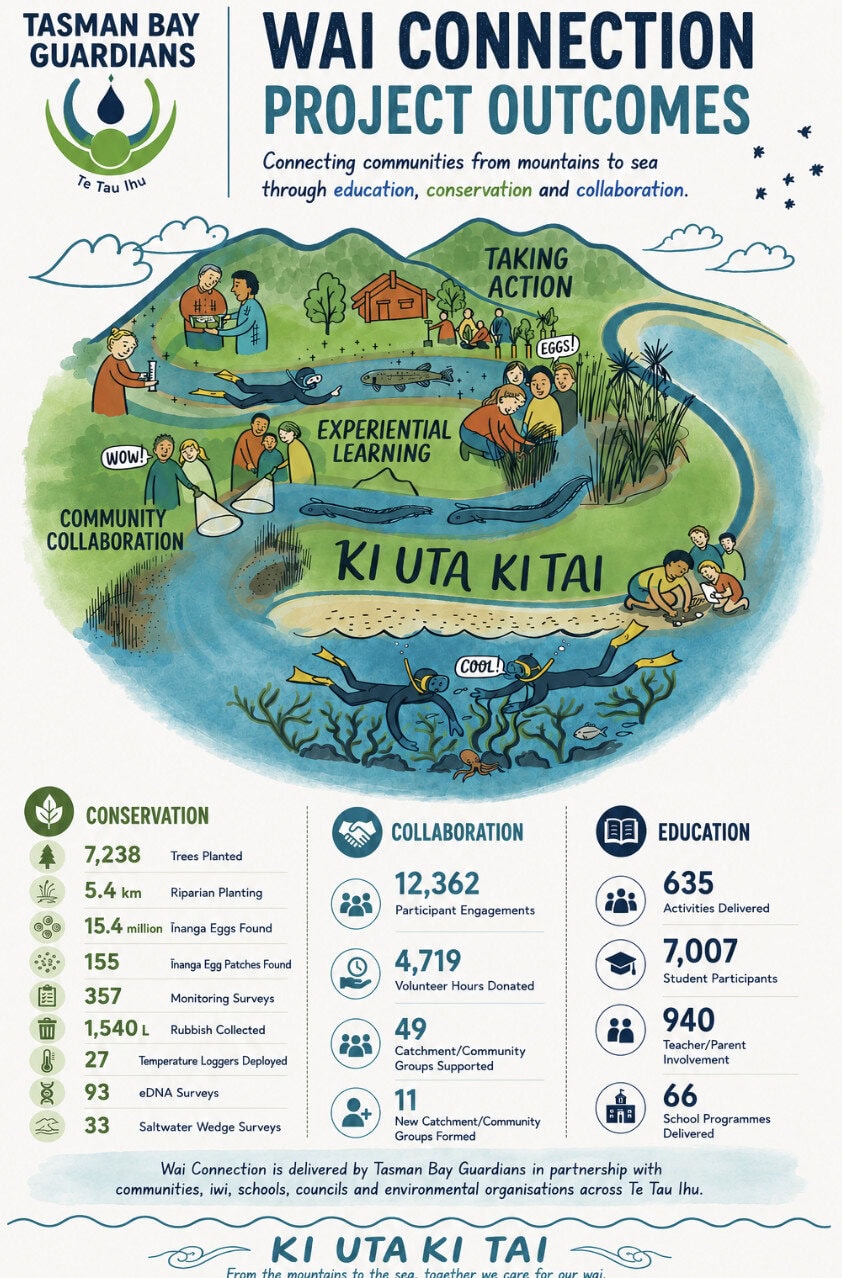
Wai Connection by the numbers
Over the past three years, Tasman Bay Guardians has:
- Supported 49 community and catchment groups
- Supported monitoring at more than 40 sites
- Supported more than 300 community sampling events
- Installed temperature loggers across important waterways
- Delivered freshwater education, īnanga surveys, restoration activities and community events across the region
Behind every number are people who gave their time, shared their knowledge and strengthened their connection with local waterways.
Building confident freshwater kaitiaki
A major focus of Wai Connection was helping communities gain the skills and confidence to investigate the health of their own waterways.
Participants learned to use Stream Health Monitoring and Assessment Kits, known as SHMAK, alongside tools such as eDNA sampling, temperature loggers, freshwater habitat assessments and fish monitoring methods.
Groups were supported to create monitoring plans, select appropriate sites, understand their results and connect with technical experts and other local restoration initiatives.
Many participants are now able to undertake monitoring independently, ensuring that valuable local knowledge and environmental observations continue beyond the funded project.
Supporting community-led action
Wai Connection worked alongside established groups and helped newer groups begin their freshwater journeys.
This included supporting the Motueka Catchment Collective’s network of SHMAKers, working with the Roding Catchment Group to establish baseline monitoring and an overall catchment plan following the gathered science collated, assisting community groups across Nelson and Tasman, and supporting West Coast farmers of Golden Bay to investigate the streams and rivers flowing through their properties.
Monitoring did more than generate data. It helped communities identify pressures such as high summer water temperatures, understand the importance of riparian vegetation and habitat, and make informed decisions about future restoration.
Working alongside Mana Whenua
Partnerships with mana whenua have been a vital part of Wai Connection.
Tasman Bay Guardians has supported freshwater monitoring, cultural health assessment, eDNA sampling, īnanga surveys, restoration planning and taiao events alongside iwi and mana whenua groups across Te Tauihu.
This mahi has brought together mātauranga Māori and scientific monitoring approaches, while supporting mana whenua aspirations and strengthening local capacity for continued monitoring and restoration.
At Waitapu, monitoring and restoration undertaken with Manawhenua ki Mohua included īnanga spawning habitats.
Discovering and protecting īnanga habitat
Īnanga spawning surveys were undertaken across urban, rural and coastal waterways, including sites located on farms.
These surveys identified active spawning sites and areas of potentially suitable habitat. Findings were shared with landowners and community groups, alongside practical recommendations such as fencing, riparian planting and protection from stock or disturbance.
This work helped people see the hidden life supported by their waterways and understand the importance of protecting the margins where freshwater meets the tide. This work has coincided with the reclassification of īnanga as threatened/nationally vulnerable, highlighting the growing importance of identifying and protecting their spawning habitat.
Focus Catchment Mapping
Developed and delivered by EOS Ecology, the Focus Catchment Mapping Series brought communities across the region together to build a clearer picture of the potential impacts on their local freshwater environments.
The workshops combined community knowledge with scientific information and interactive mapping to identify important habitats, environmental pressures, potential monitoring sites and restoration opportunities. The resulting maps provide practical tools to help guide future monitoring, restoration planning and funding priorities.
Bringing new technology into community monitoring
New technology, including eDNA testing through Wilderlab, complemented the citizen science data collected by community groups.
By analysing traces of DNA left behind in the water, eDNA testing helped identify the fish, insects and other species present within and surrounding local waterways. When combined with regular SHMAK monitoring, habitat assessments and local knowledge, these results provided groups with a more complete picture of freshwater health and biodiversity.
This approach gave communities access to valuable scientific information while strengthening their understanding of the species their monitoring and restoration work is helping to protect.
Connecting tamariki with their waterways
Through freshwater experiences, school programmes and community events, tamariki and rangatahi explored waterways firsthand.
They investigated water quality, stream habitat and freshwater invertebrates, learned about native fish, and considered how activities across a catchment can affect the health of rivers, estuaries and coastal environments.
These experiences supported young people to become curious, informed and active kaitiaki of te taiao.
Collaboration made it possible
Wai Connection was built on collaboration. We worked alongside community and catchment groups, mana whenua, councils, schools, landowners, scientists, environmental organisations such as NZLandcareTrust, volunteers and other programme providers.
These relationships helped connect local observations with specialist knowledge, link groups with restoration opportunities, share equipment and resources, and create stronger support networks across the region.
Our Changing Waters workshop brought more than 50 people together to share experiences, strengthen connections and discuss the future of freshwater action across Te Tauihu.
What happens next?
Although dedicated Wai Connection funding has ended, the mahi does not stop here.
Several groups now have the skills, equipment and support networks needed to continue monitoring independently. Others will require further facilitation, technical support or funding to maintain momentum and turn monitoring results into practical restoration.
Tasman Bay Guardians is seeking targeted funding to continue working with priority communities and waterways, including Pearl Creek, Wai-iti, Moutere, Kaiteriteri, Otūwhero and the West Coast farming community.
We are also developing new collaborative opportunities across Waimea, Marahau, Motueka, Mohua, Murchison and other parts of Te Tauihu.
He mihi nui
A huge thank you to everyone who has contributed to Wai Connection – Tatai ki te Wai.
Thank you to the mana whenua representatives, community monitors, catchment coordinators, farmers, landowners, volunteers, schools, students, scientists, councils, contractors, funders and partner organisations who shared their time, knowledge, energy and passion.
Most importantly, thank you to the people who will continue showing up for their local waterways.
The formal project may have finished, but the relationships, skills and commitment it helped grow will continue to strengthen freshwater restoration across our region.
Ngā mihi nui,
The Tasman Bay Guardians team